How Long Does It Take a Plasterer to Skim a Ceiling?
Wondering how long a plasterer takes to skim a ceiling in Newcastle? We explain timings, drying and what to expect from start to finish.

Ceiling Skimming in Newcastle: What the Timeline Actually Looks Like
A freshly skimmed ceiling makes a real difference to a room. But before you book a plasterer in Newcastle upon Tyne, it helps to know what you are actually signing up for in terms of time, from the moment the plasterer arrives to the point where the room is ready to paint.
The honest answer is that no two ceilings are identical. A small bedroom ceiling in a 1930s semi is a very different job to the bay-fronted sitting room of an Edwardian terrace, or the long, cracked ceiling of a Tyneside flat that has not been touched for decades. What we can do is walk you through the key stages so you know what to expect.
How Long Does It Take to Skim a Ceiling?
As a very general guide, for a straightforward skim coat on a sound, prepared ceiling, plasterers often work at roughly the following pace:
- Small bedroom ceiling: around half a day
- Average living room or double bedroom ceiling: around a full day
- Large open-plan room or a ceiling with alcoves or awkward angles: a day or more
These are rough working times for the plastering itself, not promises. Every ceiling is different, so we confirm the timeline when we quote. They also do not include drying time before you can paint, which is a separate stage and often the part that catches people out.
If the ceiling needs re-boarding before it can be skimmed (for example, a sagging lath and plaster ceiling in an older Newcastle property that has gone beyond repair), allow extra time for the boarding work on top of the skim. Lath and plaster ceilings are common in Victorian and Edwardian terraces across the city, and while some can be re-skimmed directly, others need the old material stripped and new plasterboard fixed before the skim goes on. You can read more about this kind of work on our ceiling and wall skimming page.
The Stages of a Ceiling Plastering Job
Understanding each stage helps you plan around the work rather than being caught off guard.
1. Preparation We cover floors and any furniture with dust sheets before anything else. Plastering is a messy job and we take that seriously. The existing surface is checked and any loose material is removed.
2. Priming or bonding If the ceiling is particularly porous or has been previously painted, a bonding agent or PVA coat may be needed first. This adds time (the primer needs to become tacky before plaster goes on) but it is important if you want the skim to bond properly.
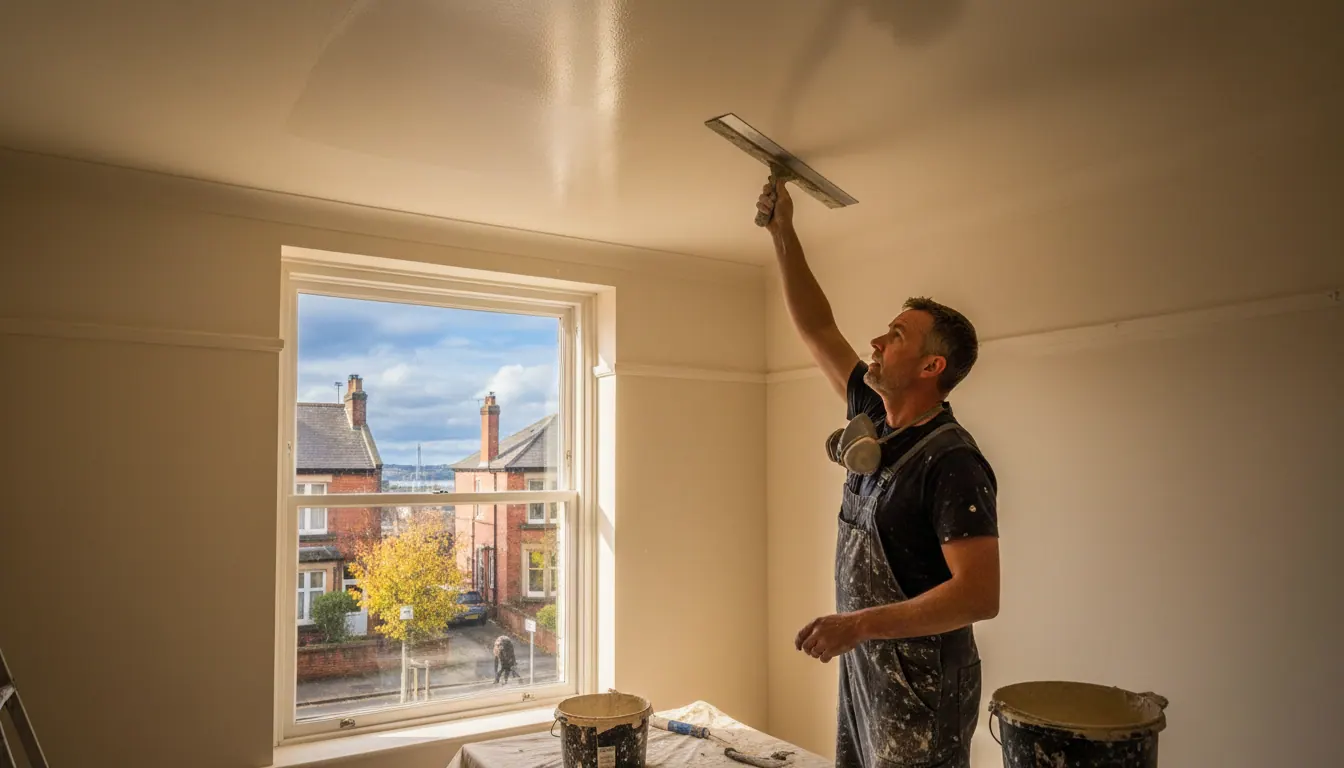
3. Applying the skim coat A skim coat is typically applied in two thin passes. The first coat goes on and is allowed to firm up slightly before the second is applied and then worked to a smooth, flat finish. This is the skilled part of the job. Getting it genuinely flat and smooth takes care, particularly on older ceilings that may have slight movement or unevenness.
4. Trowelling off and finishing Once the plaster has firmed to the right consistency, it is trowelled to a tight, polished finish. This stage can take as long as the application itself on a large ceiling.
5. Clearing up We clean up as we go and leave the room tidy before we leave. Dust sheets come down, tools are cleaned, and the floor is left as we found it.
How Long for Plaster to Dry Before Painting?
This is the question people ask most often, and it is the part of the process where patience pays off.
New plaster needs to dry out fully before it can be painted. Drying times vary a lot, so always follow the plaster manufacturer's guidance. Factors include:
- The thickness of the coat
- The temperature and ventilation in the room
- The time of year (Newcastle winters are damp and cold, which can slow drying considerably)
- Whether the property has been heated consistently
Many finishing plasters change colour as they dry, from dark and patchy to a uniform pale shade. Patches of darker colour mean moisture is still present. Do not rush this stage.
The mist coat comes first. Once the plaster is dry, the first coat of paint should be a mist coat: a diluted emulsion (a common starting point is roughly 70 per cent paint to 30 per cent water, but always follow your paint manufacturer's guidance). This seals the plaster and helps the topcoats to stick rather than flake or peel. Painting straight onto new plaster with undiluted paint is a common decorating mistake and can cause problems down the line. If you would like the painting taken care of too, take a look at our interior painting and decorating service.
Avoid blasting new plaster with a heater to speed up drying. Gentle, consistent warmth and good ventilation work far better, and forcing the process can cause the surface to crack. In a damp room, a dehumidifier can help alongside good airflow.
What About Older Newcastle Ceilings?
Many properties across Newcastle upon Tyne, particularly the Victorian terraces, Tyneside flats and Edwardian semis that make up a large part of the city's housing stock, have ceilings that have been patched, painted over multiple times or had a textured coating applied at some point. These add layers of complexity.
A word of caution on textured coatings such as Artex: in older homes they can contain asbestos, so have the coating identified before anything is sanded, scraped or otherwise disturbed.
A ceiling that looks sound might also have areas of blown plaster (where the skim has separated from the backing) that only become apparent once work starts. This is not a problem that can always be predicted from a quote visit, but we will flag it and talk through the options with you before doing anything extra.
If you have a ceiling with significant cracking, sagging or areas of movement, it is worth having a proper look done before you commit to a timeline. Sometimes a re-skim is all that is needed. Other times, re-boarding is the more sensible route and saves you dealing with the same problem again in a few years. For smaller problems, our plaster repairs service may be all that is required.
What Our Customers Say
One of the things we hear most often is that people are surprised by how tidy the job is left. Plastering has a reputation for being dusty and disruptive, which is fair, but it does not have to mean chaos.
"Fantastic service!They recently plastered my living room.The finish is absolutely flawless—perfectly smooth and ready for painting. Plastering is a messy job, but they were incredibly tidy, used dust sheets everywhere, and left the room spotless. Highly recommended, reliable, and professional!"
Soph_mo29, 5-star Google review
That is exactly what we aim for on every job, whether it is a single ceiling or a full room replaster.
Can You Plaster Walls Before the Ceiling?
Technically you can, but it is not the sensible order. Ceilings are normally plastered first. Skimming a ceiling inevitably creates some mess and splatter below, so if the walls have already been done, you risk marking fresh plaster or needing to touch up work that was already finished. Ceiling first, walls second is the standard sequence and the one that gives the cleanest result.
If you are having both a ceiling and walls plastered as part of a renovation, such as after a rewire or an extension, the whole job can be planned in the right order so nothing gets undone.
Frequently Asked Questions
How long does it take to plaster a ceiling in a typical Newcastle home? It depends on the size and condition of the ceiling. A smaller, sound ceiling is quicker than a large room, an awkward shape, or a ceiling that needs re-boarding first. We will give you a clear idea of the timeline when we come to quote.
How do I know when new plaster is dry enough to paint? Watch the colour. Fresh plaster is dark and patchy, and as it dries it generally turns a more uniform, paler shade. Drying times vary with temperature, ventilation and the time of year, so follow the manufacturer's guidance. When in doubt, give it more time rather than less.
Do I need a mist coat on new plaster? Yes. A mist coat (diluted emulsion) is the usual first coat on new plaster. It seals the surface and helps the topcoat adhere properly. Skipping it is a common cause of paint peeling on newly plastered ceilings and walls.
Can you paint wet plaster? No. Painting wet or even damp plaster traps moisture beneath the paint film, which can lead to bubbling, flaking and sometimes mould. The plaster must be fully dry before any paint goes on. If you are on a tight schedule, talk to us and we will help you plan the sequence sensibly.
Ready to Get Your Ceiling Sorted?
If you have a ceiling that needs skimming or repairing across Newcastle upon Tyne and the surrounding areas, we are happy to come and take a look. We are a fully insured, local plastering and painting team, and we quote every job individually once we understand what is needed. You can learn more about us too.
Give us a call on 07467 216111 (we are available seven days a week, 7am to 7pm) or get in touch using our contact form for a free quote.